Somewhere on your site today, a customer typed "hand cream 250 ml", got nothing useful, and left. Tomorrow another one will. By the end of the month there could be dozens of them, all asking for the same thing in their own words, and no report you own will show a single one. That is silent demand: what customers ask your website for and don't get. It stays hidden because analytics was never built to record it, not because it is rare.
What silent demand is
Silent demand is every need a customer states on your site that goes unmet and unrecorded. It comes in three forms, and each one belongs to a different team.
You don't sell it
A size, format, variant or product you don't carry. The customer wanted to buy and there was nothing to buy.
You never wrote it down
The answer exists inside your company, in a supplier sheet or someone's head, but not on your site.
Your answer is unclear
A rule exists, but the customer can't tell what it means for their order.
The split matters. A list of "unanswered questions" with no owner gets read once and forgotten. The same list split by owner turns into three sets of tasks.
If you have read our post on Failed Intent Rate, product and content gaps are its catalog and content components. Failed Intent Rate tells you how often your site fails. Silent demand is the list of what people actually wanted.
Why your analytics will never show it
GA4, heatmaps and session replay all record behaviour. They tell you a visitor viewed three product pages, scrolled 60% of the way down and left. They can't tell you why, because the reason was never an event.
The closest thing GA4 has is the view_search_results event, which stores the term a visitor typed into your site search when enhanced measurement is on. It is useful, and almost nobody reads it as demand. It holds keywords rather than the need behind them, it says nothing about whether the results helped, and it only covers the search bar.
Chat is worse. The richest statements of intent your customers make, full sentences with a size, a budget or a deadline in them, sit in Intercom, Zendesk or Tidio. Support reads them one at a time to close tickets. Nobody reads them together to decide what to stock or what to write.
The test: open your last three range or content meetings. Was any decision backed by the number of customers who asked for the thing? If not, the signal exists in your stack and isn't reaching the people who decide.
Where it already lives in your stack
You don't need a new tool to start. Silent demand is already being collected in at least three places.
| Source | What it holds | How to get it out |
|---|---|---|
| Site search | Terms typed, including the ones that returned nothing | GA4: Reports › Engagement › Events › view_search_results, add the Search term dimension, download CSV. Algolia: Analytics › No results. |
| Chat and help desk | Full questions in the customer's words, and what the bot or agent replied | Conversation exports from Intercom, Zendesk, Chatbase, Tidio, LiveChat, Gorgias or Crisp |
| Support inbox | The same ten questions asked every week | Your help desk's ticket export |
Thirty to ninety days from any one of these is enough to see the pattern.
What it looks like when you read it
Here is one week from Roast & Origin, the demo coffee store we use to test AskVio. These are demo numbers, not a customer's, but the shape is what you will see on a real site.
Read as exits, this is noise. Read as demand, it is two decisions: whether to stock capsules, and whether to publish a subscription page. Neither appears anywhere in GA4. Both were stated in plain words by customers who then left.
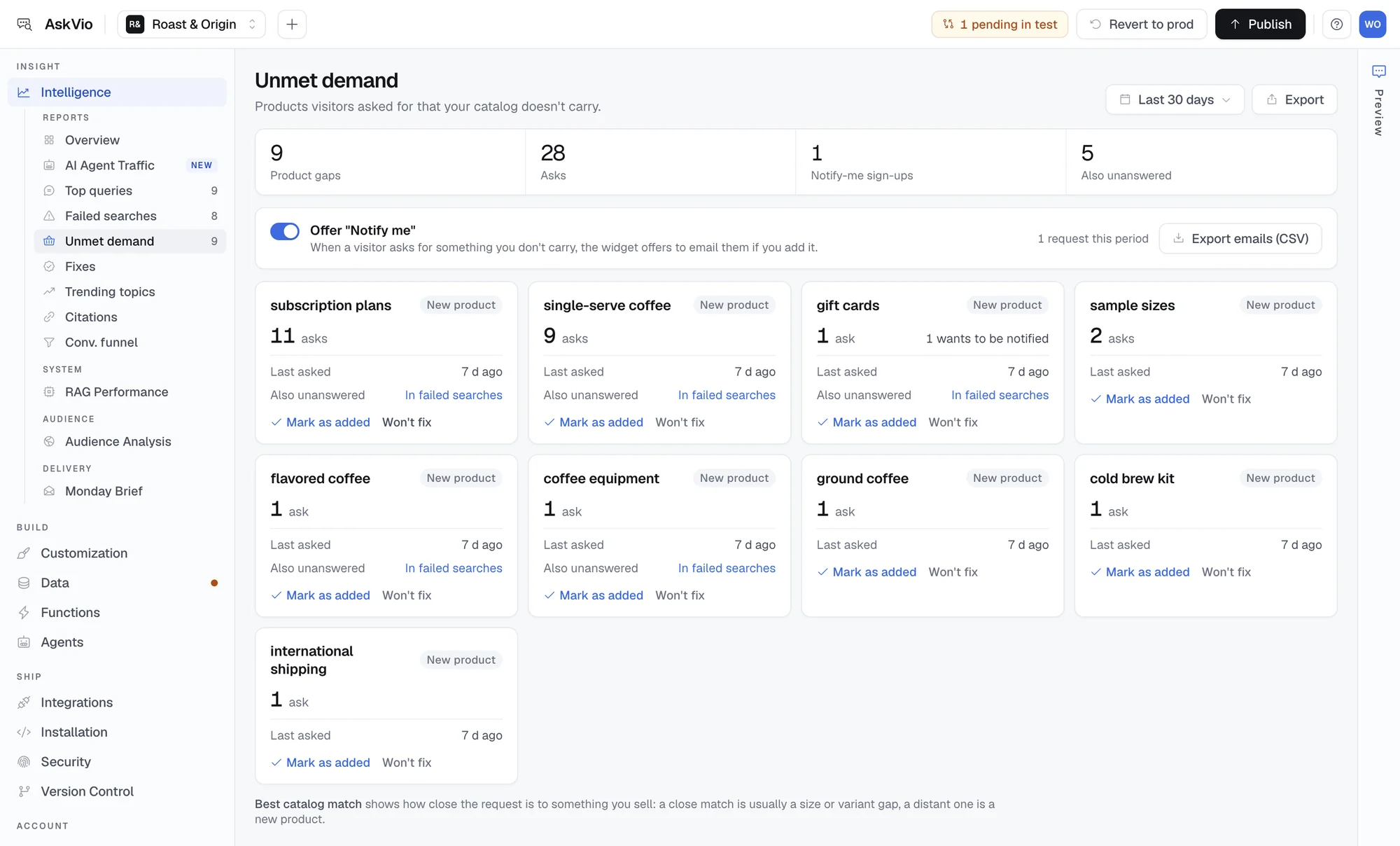
Product gaps on the demo store, ranked by how often they were asked.
Three questions for every gap
What kind of gap is it?
Product, content or policy. This decides who owns the fix.
How often, and is it growing?
One ask is an anecdote. Ten in a week, rising, is a trend. Count needs, not phrasings: "250 ml", "a bigger size" and "the large one" are the same request.
What is it worth?
A rough figure moves a range meeting further than a long list. The next section shows how to get one.
Then pick one. The value of the exercise is the fix you make on Monday, not the length of the list.
Putting a number on it
You don't need attribution to estimate silent demand. A conservative calculation is enough to rank gaps against each other.
An illustration with invented inputs: 67 asks a month for a 250 ml size, one in five of those visitors would have bought, and an average order of €35. That gives 67 × 0.2 × €35, about €470 a month or €5,600 a year, from one missing size.
Use your own inputs. For the share who would have bought, start from the conversion rate of sessions that used search, which you can read in GA4 by comparing sessions with and without a view_search_results event. It is a better proxy than your site average.
There is a better input than any assumption: ask. When a visitor requests something you don't sell, offer to notify them if you add it. Sign-ups per gap are demand with an email address attached, and they turn the estimate into a list of buyers.
Measure your silent demand this week
Export one source
30 to 90 days of site search terms or chat transcripts. One source is enough to start.
Remove personal data
Names, email addresses, phone and order numbers.
Group by need
Merge every phrasing that needs the same answer into one row.
Tag and count
Mark each group as product, content or policy, and count the asks.
Rank and fix one
Order by count and estimated value. Make the top fix and write down the date.
Count again in four weeks
If the fix worked, asks for a content or policy gap fall, and a product gap turns into sales.
A spreadsheet and an afternoon will handle a few hundred lines. Beyond that, grouping by hand gets slow and inconsistent. That is the part we automated.
Or send us the file
The Silent Demand Audit does steps 2 to 5 for you. Upload an export from Intercom, Zendesk, Chatbase, Tidio, LiveChat, Gorgias or Crisp, or your GA4 or Algolia search terms. You get back the top gaps with counts, split into products you don't carry and information your site doesn't give, plus the one fix worth making first, in the same format as our weekly Monday Brief.
Emails and phone numbers are removed before analysis, and the file is deleted once the report is ready.
Find your silent demand
Free audit. No install, one export file, a ranked list of what your customers asked for and didn't get.