
Most chatbot comparisons rank tools on how well they answer. In 2026 that is the wrong question: every serious tool now answers from your content well enough. The difference that matters to a head of ecommerce is what the tool tells you afterwards. Which questions did shoppers ask? Which ones went unanswered? Which products did they want that you don't sell? We looked at seven popular tools through that lens.
The lens: what you learn about your customers
A chatbot sits on the one channel where customers tell you, in their own words, what they want. Whether that signal reaches the people who decide what to stock, write or fix depends on the tool. We looked at each one with four questions:
- Can you read what customers asked? The actual questions, not only conversation counts.
- Does it separate answered from unanswered? A question the bot couldn't answer is the most valuable line in the log.
- Does it group and rank the gaps? Thirty shoppers asking for the same size in thirty different phrasings is one decision, not thirty rows.
- Does it reach the people who decide? A weekly summary, an export, events in GA4, or only a dashboard someone has to remember to open.
Disclosure: This post is published by the AskVio team, and AskVio is one of the seven tools. We describe competitors from their public documentation and our own use of their products, and vendors ship fast. Check each tool's current feature list before you decide, and run your own test on your own traffic.
At a glance
| Tool | Built for | What its reporting tells you |
|---|---|---|
| Tidio | Live chat plus AI for small Shopify stores | Conversation volume, Lyro resolution, and questions Lyro couldn't answer so you can add them as answers |
| Gorgias | Post-purchase support on Shopify | Ticket volume, topics, automation rate and CSAT. Strong on support load, not on pre-purchase demand |
| Chatbase | A chatbot trained on your content | Chat logs, with topic and sentiment views on paid plans |
| Intercom Fin | Support automation at scale | Resolution rates, topics and content gaps for the support team |
| SiteGPT | A simple chatbot from your URL | Chat history and basic usage counts |
| Freshdesk Freddy | AI inside a helpdesk | Ticket-based reporting and deflection |
| AskVio | Hearing what customers couldn't find | Unanswered questions, unmet product demand and failed searches, grouped and ranked, plus a weekly brief and GA4 events |
The pattern is clear once you line them up. Support tools report on support: tickets, deflection, satisfaction. Chatbot builders report on the chatbot: conversations and messages. Very few treat the questions themselves as merchandising data.
1. Tidio
Tidio is one of the most widely used ecommerce chat tools, with a polished Shopify app and a fast setup. Its Lyro AI answers from the Q&A and content you give it, and hands over to a human when it can't.
What it tells you about your customers: how many conversations you had, how many Lyro resolved, and a list of questions Lyro couldn't answer so you can write the missing answer. That list is useful for keeping the bot accurate. It is framed as bot training, not as demand: it doesn't tell you that forty shoppers this month wanted a product you don't stock.
Strengths
- Native Shopify and WooCommerce integration
- Live chat and AI in one tool
- Unanswered questions surfaced for the support team
Blind spots
- Insight is aimed at improving the bot, not the catalog
- Little grouping of similar questions into one gap
- Lyro is priced as an add-on
2. Gorgias
Gorgias is the ecommerce helpdesk. Its deep Shopify access lets it look up orders, process returns and apply discounts inside the conversation, and its AI Agent handles routine order-status and policy questions.
What it tells you about your customers: a lot about support. Ticket volume, topics, automation rate, response times and satisfaction are all well covered. Because it is built around tickets, the questions it sees are mostly post-purchase: where is my order, how do I return this. The shopper who asked for a size you don't carry and left before buying rarely becomes a ticket.
Strengths
- Deepest Shopify integration of the group
- Can take real actions on orders
- Mature support and satisfaction analytics
Blind spots
- Reporting is about support load, not pre-purchase demand
- Per-ticket AI pricing grows with volume
- Overkill if you only want discovery questions
3. Chatbase
Chatbase made "train a chatbot on your website" a category. Crawl your URLs, upload documents, and the bot answers from that content. For a general knowledge-base assistant it is fast and accurate.
What it tells you about your customers: you get the chat logs, and paid plans add topic and sentiment views. That is enough to skim what people talk about. Turning it into a ranked list of what customers wanted and didn't get is still work you do yourself, reading conversations one by one.
Strengths
- Accurate answers from documents and pages
- Very fast setup
- Many integrations (Zapier, Slack, WhatsApp)
Blind spots
- Analytics are mostly logs and counts
- No view of products customers asked for and you don't carry
- No ecommerce-specific reporting
4. Intercom Fin
Fin is one of the most capable AI agents on the market, with strong answer quality and the ability to call your own APIs mid-conversation. It is built for support teams, mostly in SaaS, and priced per resolution.
What it tells you about your customers: Intercom has the most mature reporting of the support tools, including topic analysis and suggestions for content that would let Fin resolve more. All of it is aimed at the support team and at raising the resolution rate. A merchandiser looking for missing products or sizes would have to dig for it.
Strengths
- Top-tier answer quality
- Deep reporting and topic analysis
- Custom actions against your APIs
Blind spots
- Insight is organised around support, not demand
- Per-resolution pricing makes cost hard to predict
- Heavy for a mid-size store
5. SiteGPT
SiteGPT is a simple chatbot builder: give it a URL and get a working assistant back. For a small site that wants an "ask us anything" box, it is one of the easiest paths.
What it tells you about your customers: chat history and usage counts. If you want to know what people asked, you read the transcripts.
Strengths
- Very fast setup
- Competitive pricing
- Fine for small content sites
Blind spots
- Minimal analytics
- No grouping or ranking of unanswered questions
- No ecommerce reporting
6. Freshdesk Freddy AI
Freddy is the AI layer of the Freshdesk suite. If you already run support on Freshdesk, it adds ticket triage, suggested replies and a self-service bot on your help center.
What it tells you about your customers: what the helpdesk tells you: ticket volume, categories, deflection and agent performance. It is good reporting for a support manager. Questions from shoppers who never opened a ticket stay out of view.
Strengths
- Solid ticket reporting
- Natural fit if you already use Freshdesk
- Useful agent-assist features
Blind spots
- Insight is limited to what becomes a ticket
- Thin ecommerce features
- Per-agent pricing
7. AskVio

AskVio is the tool we build, so read this section with that in mind. It answers visitors from your own content like the others, and says so when it doesn't know. It was built for the other half of the job: telling you what customers asked for and couldn't find.
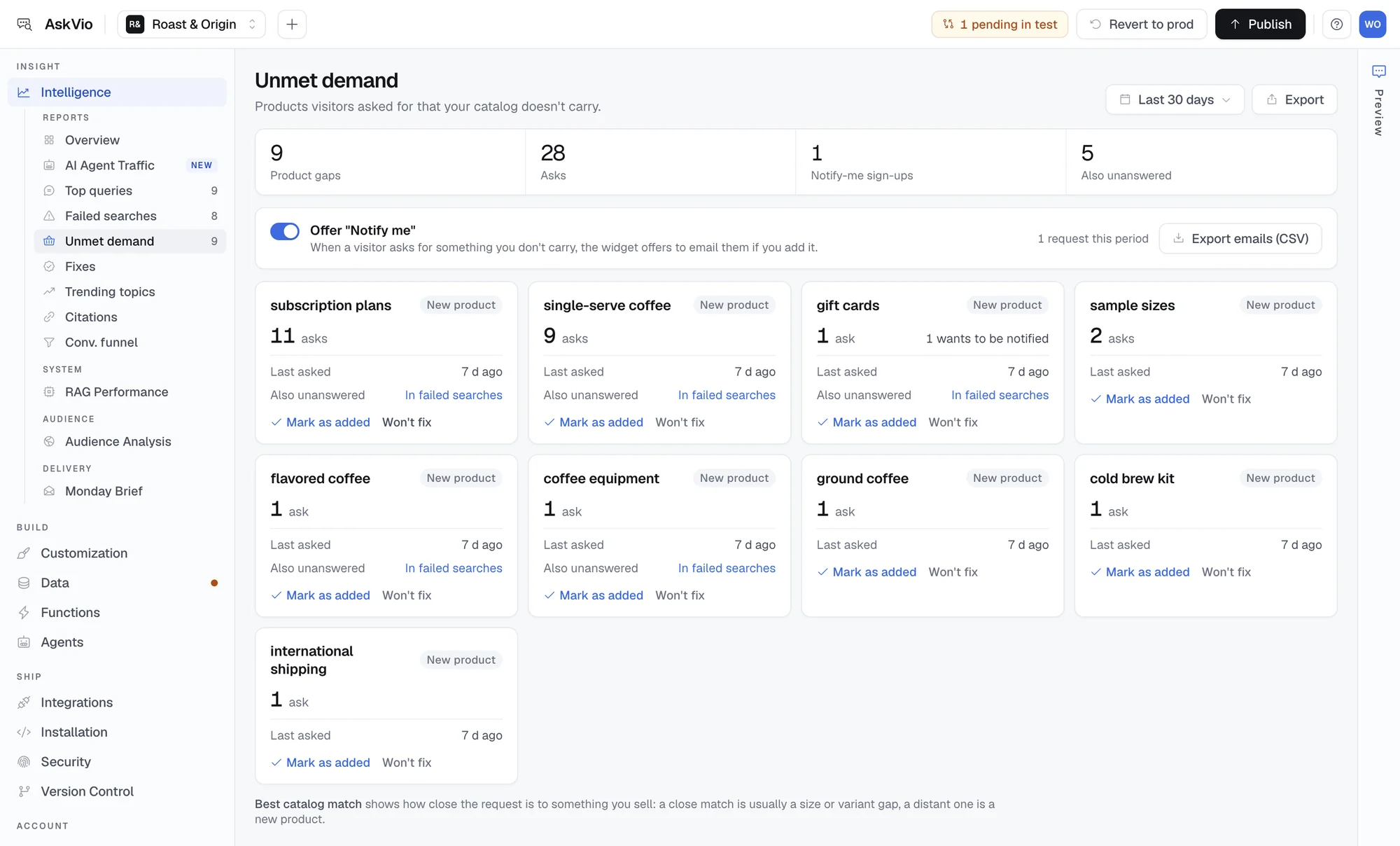
What it tells you about your customers: every unanswered question is kept in the customer's own words, grouped with similar ones and counted by asks and distinct visitors. The Intelligence dashboard ranks failed searches, unmet product demand and trending topics, and the Monday Brief emails the top gaps and one recommended fix each week. Every answer, refusal and gap is also sent to your GA4 as an event, so your analyst can check the numbers.
Strengths
- Unanswered questions grouped and ranked as gaps
- Unmet product demand, not only support topics
- Weekly Monday Brief for people who never open a dashboard
- Events in your own GA4
- Can analyse an export from the tool you already use
Blind spots
- No live agent handoff or order actions: it is not a helpdesk
- No native Shopify app yet
- Newer, with a smaller community
Which one should you use?
Start from the question you need answered.
- "How do I handle more support with the same team?" Gorgias on Shopify, Intercom Fin if budget allows, Freshdesk Freddy if you already run Freshdesk.
- "I want live chat with some AI on a small Shopify store." Tidio.
- "I want an assistant that answers from my documents, fast." Chatbase, or SiteGPT for the simplest setup.
- "What do my customers want that I'm not giving them?" That is the question AskVio is built for.
These aren't exclusive. If you already run one of the tools above, its conversation export already contains the answer to the last question. You don't need to replace anything to read it.
Your chatbot already knows what your customers wanted and didn't find. The question is whether anyone who decides what to stock ever hears it.
About this comparison
Updated October 2026. Descriptions of other tools are based on their public documentation and pricing pages and on our own use of their products; features change often, so check each vendor before deciding. Pricing shown is the entry point listed publicly at the time of writing. We have no commercial relationship with the other vendors.
Already have a chatbot? Send us the export.
Run a free Silent Demand Audit on the conversations you already have, from Intercom, Gorgias, Tidio, Chatbase, Zendesk or your site search. You get back the top gaps ranked, with the one fix worth making first. No install, no account.