70.6% of AI-generated traffic lands in GA4 as "Direct." Not because it's direct traffic. AI agents don't send referrer headers. The fastest-growing traffic channel on your site is invisible to every analytics tool you have. Here's what's happening, why it matters, and how to measure it.
The new visitor your analytics can't see
When someone types "does Brand X ship to Italy" into ChatGPT, the assistant doesn't always just answer from memory. For product questions, policy queries, and current inventory, it browses. It visits pages, reads content, extracts what it needs, and composes an answer for the person who asked.
That visit appears in your server logs. It does not appear in GA4 as anything attributable. It lands in "Direct," where it gets lumped together with people who typed your URL from memory and newsletter clicks that dropped their UTM parameters.
This is not a traditional bot. A Googlebot crawl is systematic, disclosed, and carries no purchase intent. An AI agent visit is goal-directed: a human asked a specific question, and the agent came to your site to answer it. The intent behind that visit is explicit in a way a session from organic search never is.
How an AI agent visit works: the human never leaves ChatGPT, but your server gets the request.
Why AI traffic goes dark
When a person clicks a link in a browser, the browser sends a Referer header with the request, telling the destination site where the visitor came from. GA4 uses this to attribute the session to its source.
AI agents frequently don't send that header. The agent's HTTP request looks like a direct visit. Loamly analyzed 446,405 visits from confirmed AI sources and found that 70.6% arrived without a referrer. GA4 attributed all of them to "Direct."
The 29.4% of AI traffic that does carry a referrer is all you're currently measuring. You're making decisions about a channel you can see only a third of.
The compounding problem: AI agent traffic is growing 8x faster than human traffic, according to HUMAN Security's 2026 report. The "Direct" bucket in your GA4 account is filling with high-intent visits you cannot identify or act on.
How much traffic are we talking about
AI platforms account for 0.32% of all website traffic globally in 2026. That sounds small. The trajectory is the issue.
Source: thestacc.com AI Search Referral Traffic Statistics, 2026
That's a 16x increase in two years. AI search visits grew 42.8% year-over-year from Q1 2025 to Q1 2026, reaching 27 billion visits per quarter globally. ChatGPT alone reached 1.1 billion monthly active users in June 2026.
ChatGPT accounts for 74.78% of AI referral traffic that does get attributed. Gemini is second at 11.56%, Perplexity third at 7.23%. Claude is the fastest-growing, up 320% year-over-year.
Source: higoodie.com 2026 AI Search Traffic Report (attributed traffic only; 70.6% of AI visits carry no referrer)
Gartner predicts traditional search volume will drop 25% by end of 2026 as AI chat takes share. The channel is not coming. It's here, and it's already sending traffic to your site.
Why this traffic converts differently
Ahrefs published their referral traffic analysis: AI search represented about 0.5% of total visits, but 12.1% of all sign-ups. That's a 23x higher conversion rate than organic search.
Visibility Labs ran a separate analysis across 94 ecommerce sites over 12 months. ChatGPT referrals converted at 1.81% versus 1.39% for non-branded organic search — 31% higher.
"If AI-referred traffic converts at 23x the rate of organic search, and 70% of it lands in 'Direct' in GA4, you have no idea which of your 'Direct' conversions came from an AI recommendation."
The reason isn't a mystery. A person who asked ChatGPT "does Brand X offer free returns on shoes" and then clicked through to your site already knows what they want. They're not browsing. They're verifying. The research happened inside the AI, not on your site. By the time the visit registers in GA4, the decision is close to made.
That's a fundamentally different visitor than someone who found you through a keyword search. But GA4 can't distinguish them.
What agents actually ask when they visit
Here's what no existing analytics tool captures.
When an AI agent visits your website, it arrives with a specific question. Not a keyword, not a session. A sentence. These are direct, stated purchase-intent signals. A Google analytics session doesn't carry that. A heatmap doesn't capture it.
Each of these queries exists in the AI's context and then disappears. Without a tool that intercepts them, you have no record of what was asked, whether you answered it, or what product gaps they revealed.
The last query in that list is the most important one to notice: "Do you ship to Italy?" If your site doesn't carry that information in a form the agent can find, it tells the user you don't. You lose the sale without ever knowing the conversation happened.
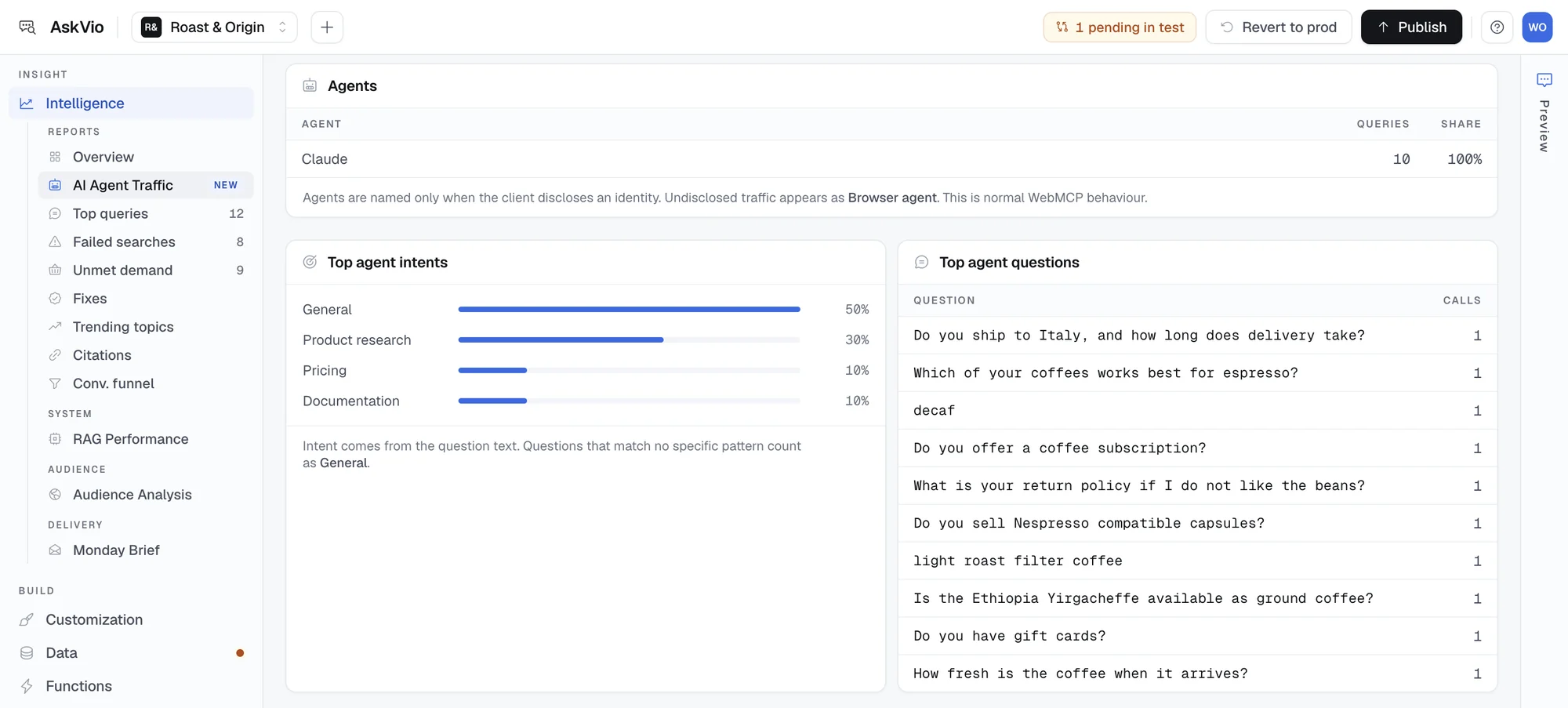
Agent queries in the AskVio dashboard: each row is a question an AI assistant asked on behalf of a human user.
How WebMCP changes the picture
In August 2026, OpenAI shipped WebMCP support in ChatGPT Desktop. The idea is direct: instead of scraping your pages and guessing at the answers, ChatGPT can call structured tools your site registers. Three of them: ask_site(), search_site(), and get_source().
When a ChatGPT user asks a question about your brand, the agent calls your tools instead of reading raw HTML. It gets your answer, from your content, sourced accurately. And for the first time, that call is logged.
You register WebMCP tools
One script tag. AskVio indexes your content and registers ask_site(), search_site(), and get_source() automatically. No developer sprint, no API integration.
ChatGPT discovers the tools
When a user asks ChatGPT a question about your brand, the assistant sees your registered tools and calls them directly, rather than scraping your pages.
The query appears in your analytics
The tool call is logged. You see the exact question the agent asked, which source it pulled, and whether your site provided an answer. For the first time, agent traffic is visible as its own channel.
Shopify storefronts are already WebMCP-enabled through Shopify's partnership with OpenAI. Expedia, Instacart, and Target are experimenting with the standard. The sites that register tools now will have a six-month head start on the sites that wait.
Why this matters for accuracy: When an agent scrapes your pages, it guesses. Missing content, outdated prices, and ambiguous product descriptions all become AI hallucinations about your brand. WebMCP tools return your actual answers from your actual content. That's the difference between ChatGPT recommending you and ChatGPT getting you wrong.
What the data looks like when you can see it
This is what one month of agent analytics looks like on an e-commerce site running AskVio with WebMCP enabled:
AskVio dashboard, AI agent queries, September 2026. The 14% no-answer rate represents 35 queries where the agent couldn't find what it needed on this site.
The 14% no-answer rate is the number worth acting on first. It means 35 agent queries came in for information the site couldn't provide. Each is a customer question that went unanswered, asked on behalf of someone who was ready to buy.
The two product gap signals (size XL navy jacket, vegan leather belt) are demand data. Without agent analytics, those questions don't exist anywhere in your reporting. With it, your product team has a direct line to what customers are asking AI assistants when they're about to make a purchase decision.
Compare to the alternative: Without WebMCP, those 248 queries either hit your site as unattributed "Direct" visits or never reached you at all. Either way, you got no signal. With WebMCP, every query is logged, structured, and actionable.
The analytics community talks a lot about attribution. This is an attribution problem with a cleaner solution than most. You don't need a new methodology or a longer attribution window. You need a structured channel that logs its own traffic. That's what WebMCP is. And right now, most websites don't have it.
Make your AI agent traffic visible
AskVio registers your WebMCP tools, indexes your content, and shows you both human and agent queries in one dashboard. One script tag. No developer required.
Sources
- Loamly. AI Traffic Attribution Study. Analysis of 446,405 confirmed AI-source visits. 2026. Finding: 70.6% arrived without referrer headers.
- thestacc.com. AI Search Referral Traffic Statistics. 2026. AI referral traffic grew 527% YoY; AI share of global web traffic: 0.02% (2024), 0.24% (2025), 0.32% (2026).
- HUMAN Security. Bot Baseline Report. 2026. AI agent-driven traffic grew 7,851% year-over-year in 2025.
- FirstMotion Research. AI Search Quarterly Report, Q1 2026. AI search visits grew 42.8% YoY, reaching 27 billion quarterly visits globally.
- higoodie.com. 2026 AI Search Traffic Report. ChatGPT: 74.78% of attributed AI referral traffic; Gemini 11.56%; Perplexity 7.23%.
- OpenAI. ChatGPT Monthly Active Users: 1.1 billion (June 2026 announcement).
- Gartner. Forecast: traditional search volume to decline 25% by end of 2026.
- Ahrefs. Internal referral traffic study. AI search: approx. 0.5% of visits, 12.1% of sign-ups (23x conversion rate). 2026.
- Visibility Labs. ChatGPT Referral Conversion Study. 94 e-commerce sites, 12 months. ChatGPT referrals convert 31% higher than non-branded organic search. 2026.
- OpenAI. ChatGPT Desktop WebMCP support shipped August 25, 2026.